




If you've ever run Meta Ads for your business, you've probably experienced the same frustration many service providers face. You launch a campaign, spend money on ads, get a few clicks, maybe even a handful of leads, and then wonder why those leads aren't turning into paying customers.
The truth is that successful advertising on Facebook and Instagram isn't just about creating eye-catching creatives or targeting the right audience. More often than not, the difference between campaigns that generate revenue and campaigns that waste budget comes down to one thing: having a proper funnel.
Many service businesses expect a stranger to see an ad and immediately book a consultation, request a quote, or purchase a service. While that can happen occasionally, it's rarely how people make buying decisions in 2026. Consumers are more informed than ever. They research, compare options, read reviews, visit websites, and often interact with a brand multiple times before taking action.
That's why every successful Meta Ads Funnel for Service Businesses is built around understanding the customer's journey rather than pushing for an immediate sale.
Whether you're a digital marketing agency, legal consultant, financial advisor, real estate professional, healthcare provider, or home service company, the principles remain the same. Your prospects move through several stages before becoming customers, and your advertising should support them at each step.
What Is a Marketing Funnel?
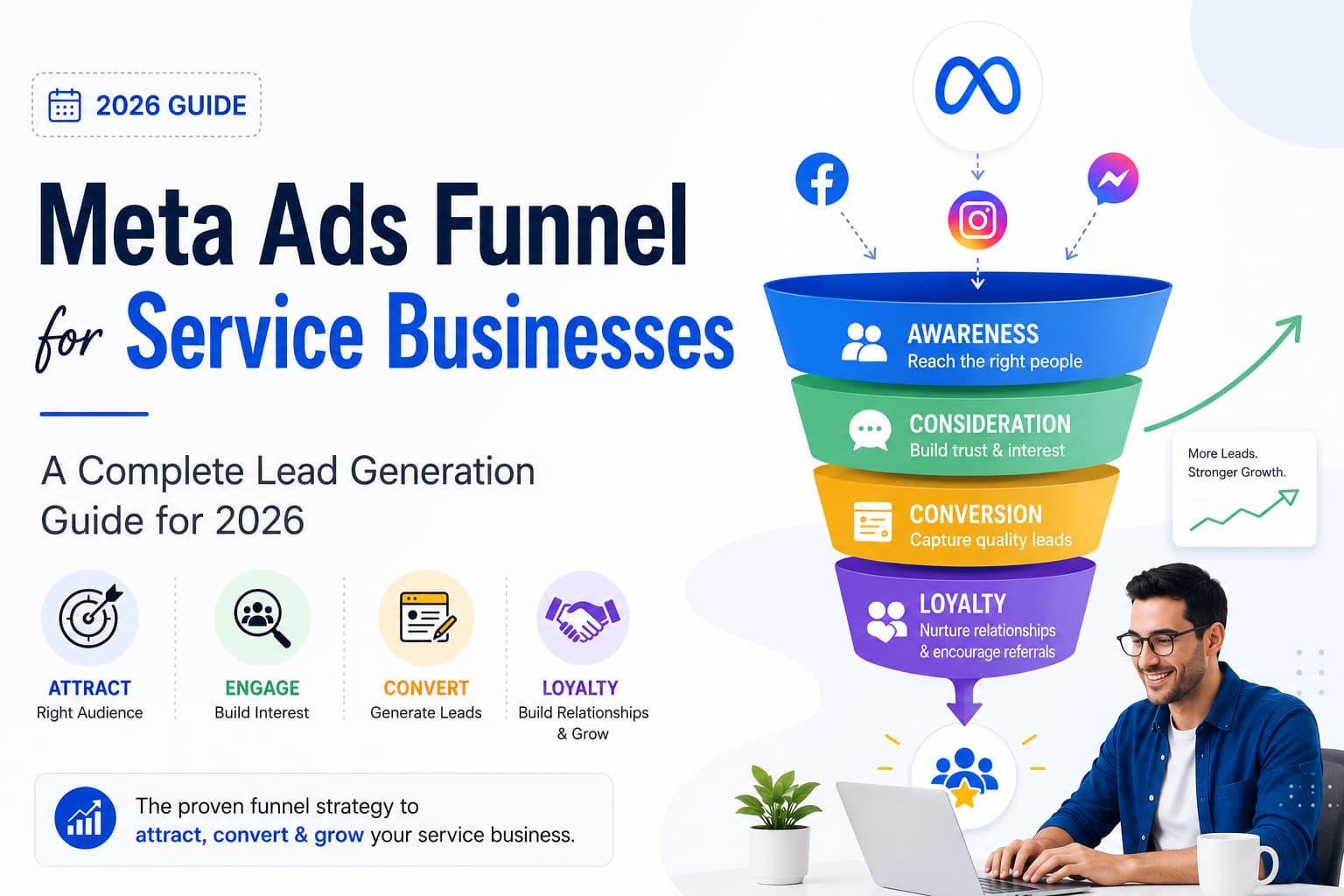
A marketing funnel is a visual representation of the path a potential customer takes from discovering your business to becoming a loyal customer.
While the exact funnel can vary depending on your industry, business model, and goals, the basic framework remains remarkably consistent. Every customer starts as a stranger. Over time, they become familiar with your brand, begin considering your services, decide whether to buy, and eventually determine whether they'll continue doing business with you.
Think about your own buying behavior. If you're looking for a marketing agency, a lawyer, or even a fitness coach, you're unlikely to hire the first company you come across. You'll probably explore a few websites, check reviews, compare pricing, and evaluate expertise before making a decision.
Your prospects behave the same way.
This is why an effective Meta Ads strategy focuses on guiding people through the entire process instead of trying to force a conversion too early.
The four main stages of the funnel are:
- Awareness
- Consideration
- Conversion
- Loyalty
Let's break down each stage and see how it contributes to a successful Facebook Ads funnel and Instagram Ads funnel.
Stage 1: Awareness – Getting on Your Prospect's Radar
This is where the relationship begins.
At the awareness stage, people are discovering your business for the first time. They may have seen one of your ads, watched a video, engaged with a Reel, or come across your content while scrolling through social media.
The biggest mistake service businesses make at this stage is trying to sell immediately.
Imagine you've never heard of a company before and the first thing they show you is a "Book a Consultation Today" advertisement. Unless you're actively looking for that service right now, chances are you'll keep scrolling.
People need a reason to pay attention first.
An effective awareness campaign introduces your business without asking for much in return. The goal is to educate, entertain, or provide value while establishing credibility.
For example:
- A real estate consultant might share insights about local property trends.
- A digital marketing agency could explain common advertising mistakes businesses make.
- A financial advisor may create content around budgeting or investment planning.
- A home renovation company might showcase before-and-after transformations.
The objective isn't to generate immediate sales. It's to become familiar.
In advertising, familiarity matters more than many businesses realize. People naturally trust brands they've seen multiple times. Even if they don't engage with your content today, they'll be more likely to recognize your name when they need your services later.
This is also where lookalike audiences can be incredibly effective. By creating audiences similar to your existing customers, Meta can help you reach new people who are more likely to be interested in what you offer.
Stage 2: Consideration – Building Trust and Interest
Once people become aware of your business, they move into the consideration phase.
This is where things start getting interesting.
At the consideration stage, prospects recognize your brand and begin evaluating whether your service can solve their problem. They're researching options, comparing providers, and looking for evidence that you can deliver results.
This is often the stage where businesses either gain trust or lose attention.
Many service providers assume that prospects understand their value automatically. In reality, potential customers are asking themselves questions like:
- Can I trust this company?
- Have they helped businesses like mine before?
- What makes them different from competitors?
- Are their results genuine?
- Is their service worth the investment?
Your content and advertising should answer these questions.
This is an ideal time to share:
- Case studies
- Client testimonials
- Success stories
- Educational guides
- Industry reports
- Webinar registrations
- Free consultations
This stage is also where many businesses focus heavily on Meta Ads lead generation.
Instead of asking prospects to buy immediately, you're offering something valuable in exchange for their contact information. This could be a free guide, audit, consultation, or strategy session.
Doing so allows you to begin building a proper lead generation funnel.
Why Lead Nurturing Matters

One lesson many advertisers learn the hard way is that not every lead is ready to buy today.
Some prospects convert within a few hours. Others may take weeks or even months.
We've seen businesses become frustrated because a lead didn't convert within a few days, only to discover that the same lead became a high-value customer two months later.
This is where lead nurturing becomes essential.
Email sequences, remarketing campaigns, educational content, and follow-up communication help keep your business top-of-mind while prospects continue evaluating their options.
The businesses that consistently generate quality customers aren't always the ones with the biggest budgets. They're often the ones that stay in front of prospects long enough to earn trust.
Stage 3: Conversion – Turning Interest Into Action
This is the stage every business owner cares about most.
The conversion stage is where prospects decide whether they're going to take action.
By now, they've likely interacted with your brand multiple times. They've seen your content, visited your website, read reviews, or downloaded one of your resources.
The relationship is already established.
At this point, your job isn't necessarily to persuade them that they have a problem. It's to reassure them that you're the right solution.
This is where a strong conversion campaign comes into play.
Effective conversion-focused ads often include:
- Client success stories
- Testimonials
- Detailed case studies
- Consultation offers
- Demonstrations
- Free assessments
- Strong calls-to-action
One strategy that consistently performs well is targeting retargeting audiences.
These are people who have already shown interest in your business.
For example:
- Website visitors
- Video viewers
- Social media engagers
- Previous leads
- Landing page visitors
- Form abandoners
Because these people already know who you are, they're often much easier to convert than cold audiences.
Many advertisers are surprised to discover that their highest-performing campaigns aren't aimed at new prospects. They're aimed at people who already interacted with the business but didn't take action the first time.
The Role of Landing Page Optimization
Even a perfectly structured Meta campaign can fail if the destination page creates friction.
One of the most common issues we see is businesses spending thousands on advertising while sending traffic to poorly designed pages.
Landing page optimization can have a massive impact on campaign performance.
A good landing page should:
- Clearly communicate the offer
- Build trust quickly
- Highlight benefits rather than features
- Include testimonials and social proof
- Have a clear call-to-action
- Eliminate unnecessary distractions
Sometimes improving a landing page generates more leads than increasing the advertising budget.
Lead Qualification Improves Lead Quality
Not every lead is worth pursuing.
This is especially true for service businesses where time is valuable.
Implementing a simple lead qualification process can dramatically improve sales efficiency.
By asking relevant questions inside your forms or booking process, you can identify prospects who are genuinely interested and fit your ideal customer profile.
This allows your sales team to spend more time with qualified opportunities and less time chasing poor-fit leads.
Stage 4: Loyalty – The Most Overlooked Part of the Funnel
Many businesses treat a conversion as the finish line.
In reality, it's often the beginning.
Once someone becomes a customer, your focus should shift toward retention and relationship building.
The loyalty stage is where long-term growth happens.
Acquiring customers through advertising can be expensive. Retaining existing customers is often significantly more cost-effective.
A positive customer experience can lead to:
- Repeat purchases
- Service upgrades
- Referrals
- Positive reviews
- Long-term partnerships
Some of the most successful service businesses generate a substantial portion of their revenue from existing customers and referrals.
This doesn't happen by accident.
It happens because they continue providing value after the sale.
Regular communication, excellent customer support, exclusive offers, educational resources, and referral incentives can all strengthen customer relationships.
A strong sales funnel doesn't end when a customer signs a contract. It continues long after the first transaction.
Why Meta Pixel Is Essential

If you're serious about improving campaign performance, implementing the Meta Pixel should be a priority.
Meta Pixel provides valuable data about how users interact with your website after clicking an ad.
Without accurate tracking, you're essentially making decisions based on assumptions.
With Meta Pixel, you can:
- Monitor website activity
- Track lead submissions
- Measure campaign effectiveness
- Create custom audiences
- Build lookalike audiences
- Improve audience targeting
Perhaps most importantly, it enables accurate conversion tracking, allowing you to identify which campaigns are genuinely generating results.
The businesses that scale successfully with Meta Ads are typically the ones making decisions based on data rather than guesswork.
Why Many Service Businesses Fail With Meta Ads
After working with businesses across various industries, certain mistakes appear again and again.
Some businesses focus entirely on lead generation while ignoring awareness.
Others spend heavily on awareness campaigns but never nurture leads properly.
Some rely on great ads but neglect their landing pages.
Others generate leads but have no follow-up process.
The issue is rarely a single campaign.
More often, it's a broken funnel.
When one stage is missing or poorly executed, performance suffers across the entire customer journey.
Conclusion
A successful Meta Ads Funnel for Service Businesses isn't built around a single advertisement or a clever headline. It's built around understanding how real people make buying decisions.
Most prospects won't become customers after seeing your brand once. They need time to learn about your business, evaluate their options, build trust, and gain confidence in your ability to deliver results.
That's why businesses that consistently succeed with Meta Ads lead generation focus on every stage of the funnel—from awareness and consideration to conversion and loyalty.
Whether you're building a Facebook Ads funnel, an Instagram Ads funnel, or a broader lead generation funnel, the objective remains the same: deliver the right message to the right person at the right stage of their journey.
When you combine strong creative content, audience targeting, lead nurturing, retargeting audiences, landing page optimization, conversion tracking, and customer retention strategies, Meta Ads become far more than a source of leads. They become a predictable system for business growth.
As competition continues to increase in 2026, service businesses that embrace a full-funnel approach will have a significant advantage over those still relying on one-off campaigns and short-term tactics.
Stop guessing, start scaling. Let Squareit Solutions launch your Meta ads funnel.
FAQs
What is a Meta Ads Funnel for Service Businesses?
A Meta Ads Funnel for Service Businesses is a structured advertising framework that guides potential customers through awareness, consideration, conversion, and loyalty using Facebook and Instagram advertising campaigns.
How does Meta Ads lead generation work?
Meta Ads lead generation works by attracting potential customers through targeted advertising and capturing their contact information through lead forms, landing pages, consultations, or other conversion-focused offers.
Why is lead nurturing important?
Lead nurturing helps businesses stay connected with prospects who are not ready to buy immediately. Through ongoing communication and valuable content, businesses can build trust and increase conversion rates over time.
What are retargeting audiences?
Retargeting audiences are people who have already interacted with your business, such as website visitors, video viewers, social media engagers, or previous leads. Since they're already familiar with your brand, they often convert at higher rates.
How does Meta Pixel help improve campaign performance?
Meta Pixel tracks user actions on your website and provides valuable insights for audience targeting, conversion tracking, campaign optimization, and performance measurement.
Which stage of the funnel is most important?
Every stage is important. Awareness creates visibility, consideration builds trust, conversion drives revenue, and loyalty increases customer lifetime value. The best results come from optimizing the entire funnel rather than focusing on a single stage.