


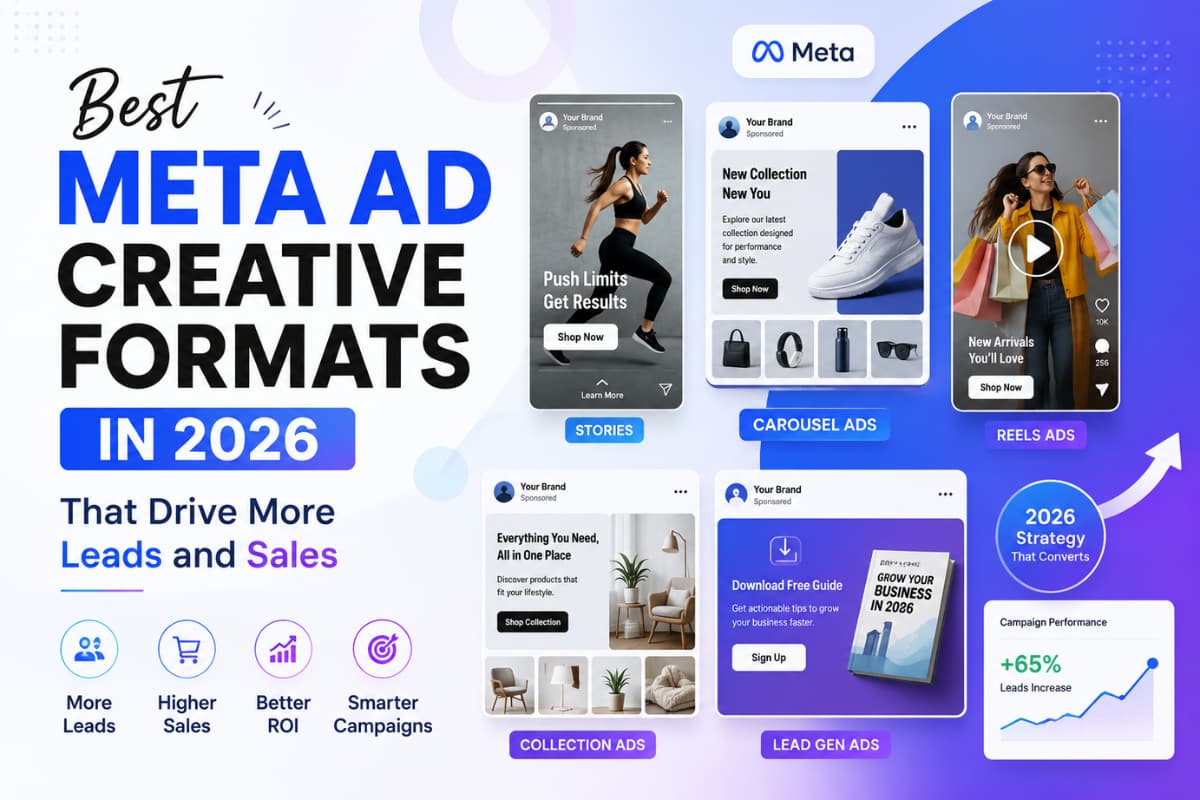
Meta ads in 2026 are really not about “just running ads” anymore. It’s more about how your creative fits into someone’s scrolling behavior on Facebook and Instagram.
You can have perfect targeting and a solid budget, but if the creative doesn’t feel natural or interesting, people will scroll past it in a second.
That’s why understanding the Best Meta Ad Creative Formats matters so much. Each format behaves differently, and each one works best at a different stage of attention—cold audience, warm audience, or retargeting.
Let’s break them down in a more practical way.
1. Image Ads (Single Static Creative)
Image ads are still everywhere, and there’s a reason for that—they’re simple and they work when you don’t overthink them.
These are best when you just want to say something clearly. No storytelling, no fancy editing. Just a strong visual and a straight message.
They usually work well for:
- Discounts and limited offers
- Product-focused ads (fashion, beauty, real estate, etc.)
- Retargeting people who already visited your page
The biggest advantage here is speed. People don’t have to “consume” anything. They just see it, understand it, and decide.
Honestly, the best-performing image ads I’ve seen are not the most designed ones—they’re the ones that look almost like regular social posts with a clear offer.
2. Video Ads (Short & Long Form)
Video is where most brands either win or lose today.
A good video ad doesn’t feel like an ad at all—it feels like content.
These work really well for:
- Showing how a product actually works
- Before-and-after results
- Explaining a service in a simple way
- Building trust when people don’t know your brand yet
The truth is, attention is the hardest currency now. And video earns it better than anything else.
But here’s the part people miss: it doesn’t need to be perfect. In fact, overly polished videos often perform worse than simple, phone-shot clips.
Short videos (6–15 seconds) usually perform best because people don’t have patience anymore. If you don’t hook them instantly, they’re gone.
A lot of brands now use UGC-style videos, where it looks like a real person talking instead of a polished ad. That’s not a trend—it’s just what people trust more.
3. Carousel Ads (Swipe Format)
Carousel ads are underrated because they look simple, but they actually give you more space to explain something without overwhelming the viewer.
They work best when you want to:
- Show multiple products
- Break a message into steps
- Compare options or features
The nice thing about carousels is that they create curiosity. Once someone starts swiping, they usually keep going.
But here’s something most advertisers get wrong: they treat each card as separate. It shouldn’t be like that.
Think of it like a mini story:
First you grab attention, then you build interest, then you close with the offer.
Also, don’t expect people to always reach the last card. The first one does most of the heavy lifting.
4. Reels Ads (Full Screen Vertical Video)
Reels ads are probably the closest thing to “native content advertising” right now.
People are not in “buying mode” when they’re watching Reels. They’re just scrolling for entertainment. So your ad has to feel like it belongs there.
These work really well for:
- Lifestyle brands
- Fashion, fitness, beauty
- Trend-based content
- Anything targeting younger audiences
What actually works here is not high production value—it’s relatability.
If it feels like something a creator would post, it performs better than something that looks like a polished brand ad.
That’s why UGC ads perform so well in Reels. They don’t interrupt the experience—they blend into it.
5. Stories Ads (Quick Vertical Ads)
Stories are fast. People tap through them quickly without thinking much.
That actually makes them powerful for urgency-based ads.
Use Stories when you want:
- Flash sales
- Limited-time offers
- Quick action like installs or signups
There’s not much time to convince someone here. You either grab attention instantly or you don’t.
Simple visuals, bold text, and a clear CTA usually work best. Overcomplicating Stories is a mistake most beginners make.
6. Collection Ads (Mini Storefront Inside Meta)

If you run an online store, Collection ads are basically Meta turning your ad into a shopping experience.
Instead of sending someone to your website immediately, they can browse products right inside Facebook or Instagram.
This works well for:
- E-commerce brands
- Fashion and lifestyle stores
- Product-heavy businesses
The biggest advantage here is convenience. People don’t feel like they’re being “redirected.” They just keep exploring.
And when people explore, they’re more likely to buy.
7. Instant Experience (Full-Screen Landing Page)
This one feels like a mini website inside Instagram or Facebook.
It loads fast, looks clean, and lets you tell a deeper story without sending people away.
It’s useful when:
- You need more space to explain something
- You’re selling higher-value products
- You want a more branded experience
Think of it as a bridge between an ad and a landing page.
It works best when you don’t just throw information at people but guide them through it step by step.
8. Lead Ads (Instant Form Submission)
Lead ads are probably the most practical format if your goal is inquiries.
Instead of sending users to a website, they just fill a form inside Facebook or Instagram.
This works really well for:
- Real estate
- Coaching and courses
- Clinics and local services
- Events and consultations
The reason they perform well is simple—less effort for the user means more conversions.
People don’t have to think too much or leave the app. That alone improves results a lot.
But keep forms short. If you ask for too much, you lose the advantage.
9. Dynamic Ads (Personalized Retargeting)
Dynamic ads are where things get really efficient.
Instead of showing the same ad to everyone, Meta automatically shows people products they already viewed or interacted with.
So if someone checked a product but didn’t buy it, they’ll see it again later.
This works especially well for:
- E-commerce retargeting
- Abandoned cart recovery
- Product recommendations
It feels almost personal to the user, and that’s exactly why it converts better.
Conclusion
If there’s one thing to understand about the Best Meta Ad Creative Formats, it’s this: there is no single “best” format.
Each one plays a different role.
Image ads are great for clarity. Video ads build attention and trust. Carousels help explain more. Reels and Stories help you reach cold audiences. Dynamic ads close the loop and bring people back.
A strong Meta Ads strategy is usually a mix of all of them, not just one.
And honestly, the biggest difference between average ads and high-performing ones is not the format—it’s how human the creative feels.
People don’t respond to “ads” anymore. They respond to content that feels real.
Want more leads and sales from Meta ads? Contact Squareit Solutions today to get started and scale your business.
FAQs
1. What are the best Meta ad creative formats in 2026?
Image ads, video ads, carousel ads, reels ads, stories ads, collection ads, instant experience, lead ads, and dynamic ads all work depending on your goal.
2. Which Meta ads perform best for sales?
Video ads and dynamic ads usually perform best because they combine attention with intent.
3. Do UGC ads really work better?
Yes, in most cases. People trust real-looking content more than polished brand ads.
4. How often should I change creatives?
Usually every 1–2 weeks, or whenever performance starts dropping.
5. What’s the easiest format to start with?
Image ads and simple video ads are the easiest and fastest to test.