





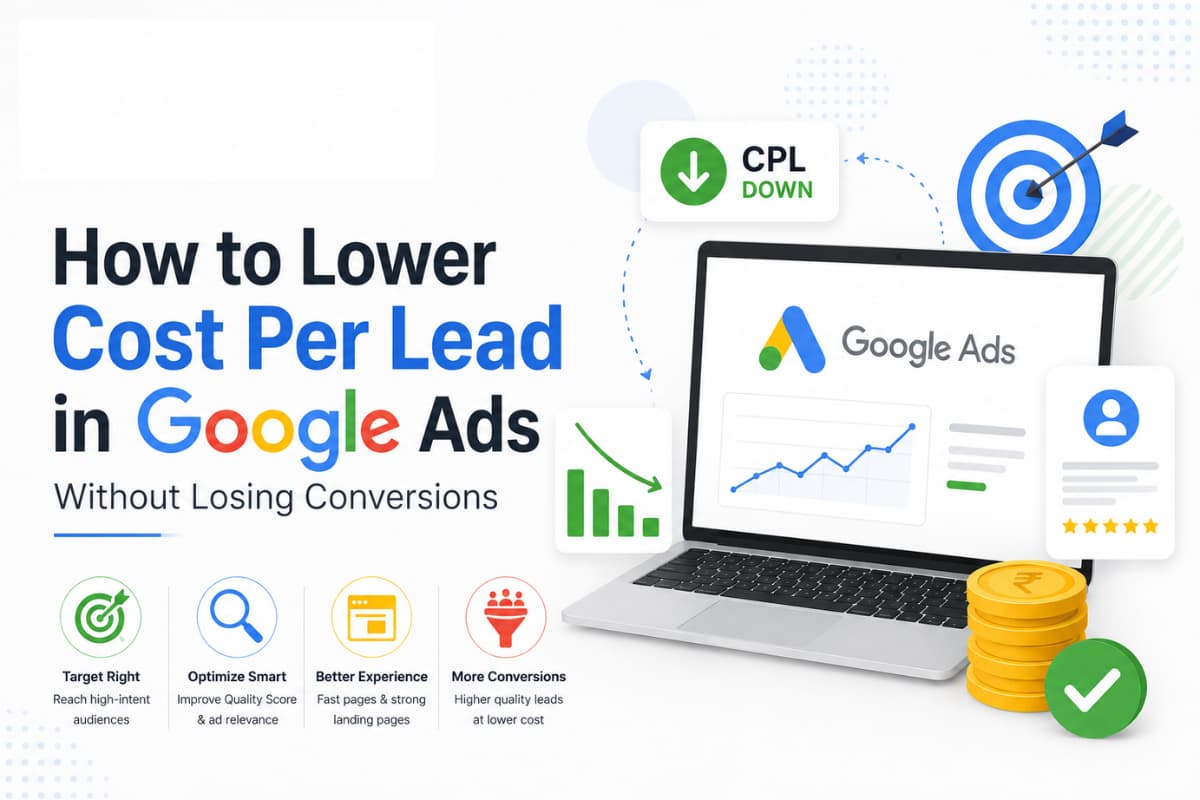
Whether you are managing a complete digital marketing campaign involving SEO, SEM, email marketing, social media, and content marketing, or you are a performance marketer looking to utilize your client's advertising budget in the most efficient way possible, one question always remains relevant: How do you Reduce Cost Per Lead in Google Ads without sacrificing conversions?
Many advertisers assume that spending more automatically leads to better results. However, successful advertising is not about spending the highest budget—it is about spending smarter. The goal is to attract high-quality leads at the lowest possible cost while maintaining or even improving your conversion rate.
Businesses of every size constantly look for ways to improve their Google Ads cost per lead because lower acquisition costs mean better profitability, increased scalability, and stronger marketing performance. The good news is that reducing your CPL does not necessarily require a larger budget. Instead, it requires continuous optimization, better audience targeting, improved landing pages, and strategic campaign management.
In this guide, we'll discuss practical methods to Reduce Cost Per Lead in Google Ads while maintaining high-quality leads and strong campaign performance.
Cost Per Lead (CPL)

Cost Per Lead (CPL) is the average amount spent to generate one qualified lead through your advertising campaigns.
For example, if you spend 40,000 on Google Ads in one month and generate 80 leads, your Google Ads cost per lead is:
40,000 ÷ 80 = 500 per lead
The lower your CPL, the more efficient your advertising becomes. However, reducing costs should never come at the expense of lead quality. A campaign generating cheap but unqualified leads ultimately wastes both time and money.
The objective should always be to achieve a balance between lower advertising costs and higher-quality conversions. When your campaigns consistently generate qualified leads at a lower cost, your overall Google Ads ROI improves significantly.
Why Lowering Your Cost Per Lead Matters
Reducing your CPL offers benefits beyond simply saving money. It allows businesses to scale their campaigns more efficiently while maintaining profitability.
Some of the major advantages include:
- Better return on advertising investment
- Higher campaign profitability
- Ability to generate more leads within the same budget
- Improved customer acquisition efficiency
- Increased opportunities to scale successful campaigns
- Better overall marketing performance
Instead of constantly increasing budgets, marketers should focus on improving campaign efficiency through continuous Google Ads optimization.
How to Reduce Cost Per Lead in Google Ads

There are plenty of ways to reduce your Cost Per Lead. From campaign optimization to improving your website and understanding your audience, every improvement contributes toward better Google Ads lead generation and a stronger Google Ads conversion rate.
Below are some of the most effective strategies.
1. Optimize Your Bidding Strategy
One of the most important ways to Reduce Cost Per Lead in Google Ads is by optimizing your bidding strategy.
Many advertisers continue spending heavily on keywords simply because they generate clicks. However, clicks alone do not generate revenue. Your advertising budget should be allocated toward keywords that consistently produce qualified leads and conversions.
Understanding user intent plays a major role here. Some search queries are informational, where users are only researching a topic, while others indicate strong purchase intent. By identifying high-intent keywords, you can focus your spending where it matters most.
Experiment with different bidding strategies depending on your campaign goals. Manual CPC offers greater control, while automated strategies such as Maximize Conversions or Target CPA can help Google optimize bids based on historical conversion data.
Review campaign performance regularly instead of setting bids once and forgetting them. Small adjustments over time often lead to significant improvements in cost efficiency.
A well-optimized bidding strategy not only helps reduce Google Ads costs but also improves campaign stability over the long term.
2. Focus on Organic Growth Alongside Paid Advertising
Paid advertising works best when combined with strong organic visibility.
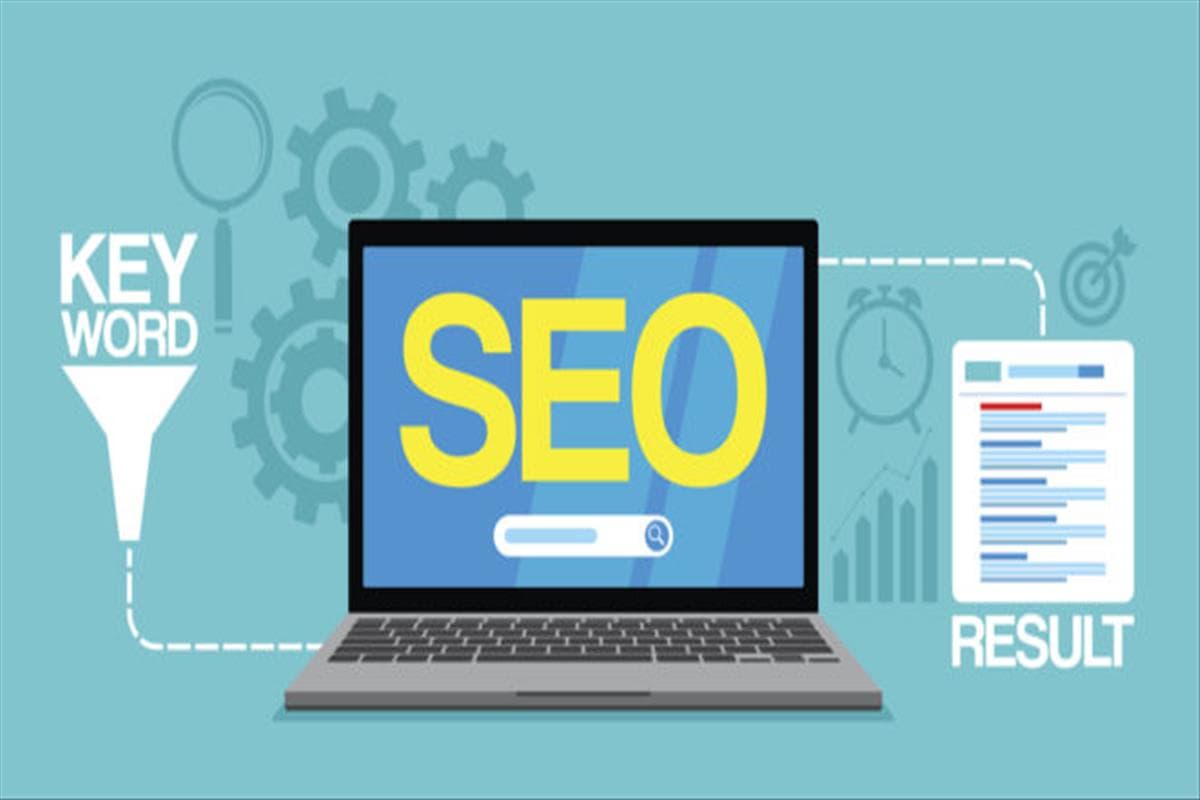
Investing in SEO through on-page optimization, technical SEO, and off-page SEO helps increase your website's visibility without requiring additional advertising spend for every visitor.
As your website begins ranking for relevant search terms, you receive qualified traffic organically. This reduces your dependence on paid advertising while increasing overall brand visibility.
Organic visitors also tend to trust businesses that appear naturally in search results, often resulting in higher engagement and stronger conversion rates.
Creating helpful blog articles, optimizing service pages, improving internal linking, and regularly publishing valuable content all contribute toward long-term growth.
Over time, combining SEO with Google Ads creates a sustainable marketing strategy that supports lower CPL and stronger Google Ads lead generation.
3. Create Detailed Customer Personas
Customer personas represent groups of potential customers who share similar characteristics, interests, goals, and purchasing behavior.
Instead of creating generic advertisements for everyone, develop several customer personas that represent different segments of your audience.
Consider factors such as:
- Age
- Profession
- Income level
- Geographic location
- Pain points
- Purchase motivations
- Search behavior
- Preferred devices
When your advertisements speak directly to these audiences, your messaging becomes far more relevant.
Higher ad relevance often results in better engagement, improved Google Ads conversion rate, and lower advertising costs.
The better you understand your audience, the easier it becomes to write compelling headlines, create persuasive ad copy, and develop offers that genuinely solve customer problems.
4. Optimize Your Website and Landing Pages
Getting someone to click your advertisement is only half the job.
Once visitors land on your website, their experience determines whether they convert into leads.
Effective landing page optimization focuses on creating a seamless user experience that encourages visitors to take action.
Your landing pages should:
- Load quickly
- Be mobile-friendly
- Match the messaging in your advertisements
- Include a clear headline
- Explain your value proposition immediately
- Feature prominent calls-to-action
- Display trust signals such as testimonials and reviews
- Minimize unnecessary distractions
Google also considers the quality and relevance of your landing pages when calculating Quality Score, which directly impacts advertising costs.
Improving your landing page experience often increases conversions without increasing ad spend.
Regularly monitor your website's Core Web Vitals, page speed, navigation, and mobile usability to ensure users enjoy a smooth browsing experience.
5. Perform Regular A/B Testing
You should always conduct A/B testing before making major campaign decisions.
Testing helps identify which headlines, descriptions, landing pages, images, calls-to-action, and offers perform best with your target audience.
Rather than relying on assumptions, A/B testing allows decisions to be based on actual user behavior.
Some elements worth testing include:
- Headlines
- Ad descriptions
- Display URLs
- Landing page layouts
- CTA button colors and text
- Forms
- Images
- Offers
- Pricing presentation
Even small improvements in click-through rate or conversion rate can significantly lower your overall CPL over time.
Continuous testing ensures your campaigns keep improving instead of becoming stagnant.
6. Improve Your Quality Score
One of the most overlooked factors affecting advertising costs is Quality Score.
Google assigns a Quality Score to your keywords based on factors such as:
- Expected click-through rate
- Ad relevance
- Landing page experience
Higher Quality Scores often result in lower cost-per-click while improving ad placement.
To improve Quality Score:
- Write highly relevant ad copy.
- Group similar keywords into tightly themed ad groups.
- Improve landing page relevance.
- Increase page speed.
- Maintain consistency between keywords, ads, and landing pages.
Improving Quality Score is one of the most effective long-term methods to reduce Google Ads costs while maintaining strong visibility.
7. Use Negative Keywords Effectively
Not every search query is valuable.
Without proper filtering, your ads may appear for irrelevant searches that generate clicks but never convert.
Adding negative keywords prevents Google from displaying your ads for searches that are unlikely to produce qualified leads.
For example, if you only offer premium services, you may exclude terms such as:
- Free
- Cheap
- Jobs
- Training
- DIY
Review your search terms report regularly to identify irrelevant searches triggering your advertisements.
Adding these terms as negative keywords helps eliminate wasted ad spend and improves campaign efficiency.
8. Set Up Accurate Conversion Tracking
Many advertisers make optimization decisions based solely on clicks or impressions.
However, the most valuable metric is conversions.
Proper conversion tracking allows you to understand exactly which keywords, ads, devices, audiences, and campaigns generate actual business results.
Track meaningful actions such as:
- Form submissions
- Phone calls
- Appointment bookings
- Purchases
- Quote requests
Accurate tracking helps Google optimize automated bidding strategies while giving marketers reliable data for future decisions.
Without proper tracking, reducing CPL becomes largely a guessing game.
9. Continuously Analyze Campaign Performance
Google Ads is not a "set it and forget it" platform.
Successful advertisers continuously monitor campaign performance and make incremental improvements.
Review metrics including:
- Click-through rate (CTR)
- Conversion rate
- Cost Per Click (CPC)
- Google Ads cost per lead
- Search impression share
- Bounce rate
- Device performance
- Geographic performance
Regular analysis helps identify opportunities to pause underperforming keywords, increase bids on profitable campaigns, and improve targeting.
Small weekly optimizations often outperform large monthly changes.
10. Focus on Conversion Quality Instead of Quantity
Generating hundreds of leads means very little if those leads never become paying customers.
Always evaluate lead quality alongside CPL.
Sometimes a campaign with a slightly higher CPL produces significantly higher revenue because the leads are better qualified.
Work closely with your sales team to determine which campaigns produce customers—not just inquiries.
This approach ensures you optimize for business growth rather than vanity metrics.
Ultimately, the goal is not simply to generate more leads but to generate better leads while improving Google Ads ROI.
Conclusion
Learning how to Reduce Cost Per Lead in Google Ads is an ongoing process rather than a one-time task. Successful advertisers consistently refine their campaigns through better audience targeting, smarter bidding, continuous testing, landing page improvements, and detailed performance analysis.
By focusing on user intent, improving Quality Score, using negative keywords, reviewing the search terms report, implementing accurate conversion tracking, and investing in landing page optimization, you can steadily lower your Google Ads cost per lead without sacrificing lead quality.
Remember that the ultimate objective is not simply to spend less but to generate more qualified leads while maximizing your Google Ads ROI. Continuous optimization and data-driven decisions will help your campaigns remain profitable and scalable in the long run. Ready to slash your CPL and scale your lead generation? check out Squareit Solutions--the best digital marketing agency in Lucknow for high ROI performance marketing.
FAQs
1. What is a good Cost Per Lead in Google Ads?
There is no universal benchmark because CPL varies across industries. Competitive sectors such as legal, finance, and healthcare generally have higher CPLs than local service businesses. The ideal CPL is one that remains profitable for your business.
2. How can I Reduce Cost Per Lead in Google Ads quickly?
Start by reviewing your bidding strategies, improving ad relevance, adding negative keywords, optimizing landing pages, and analyzing your search terms report. These changes often produce noticeable improvements within a short period.
3. Does Quality Score affect Google Ads cost per lead?
Yes. A higher Quality Score can reduce your cost-per-click, improve ad rankings, and ultimately contribute to a lower Google Ads cost per lead.
4. Why is landing page optimization important?
Even the best advertisement cannot generate leads if visitors have a poor experience after clicking. Faster loading pages, relevant content, and strong calls-to-action significantly improve conversions and reduce CPL.
5. Should I use automated bidding or manual bidding?
It depends on your campaign goals and available conversion data. Automated bidding performs well when accurate conversion tracking is in place, while manual bidding offers greater control for newer campaigns.
6. How often should I optimize my Google Ads campaigns?
Campaigns should be reviewed regularly. Weekly performance checks combined with monthly optimization help identify new opportunities to improve conversion rates and reduce advertising costs.
7. Can SEO help lower Google Ads costs?
Yes. Strong organic rankings increase website traffic without additional advertising spend. Combining SEO with paid advertising creates a balanced marketing strategy that supports lower acquisition costs and improved overall lead generation.
.png)
.png)