






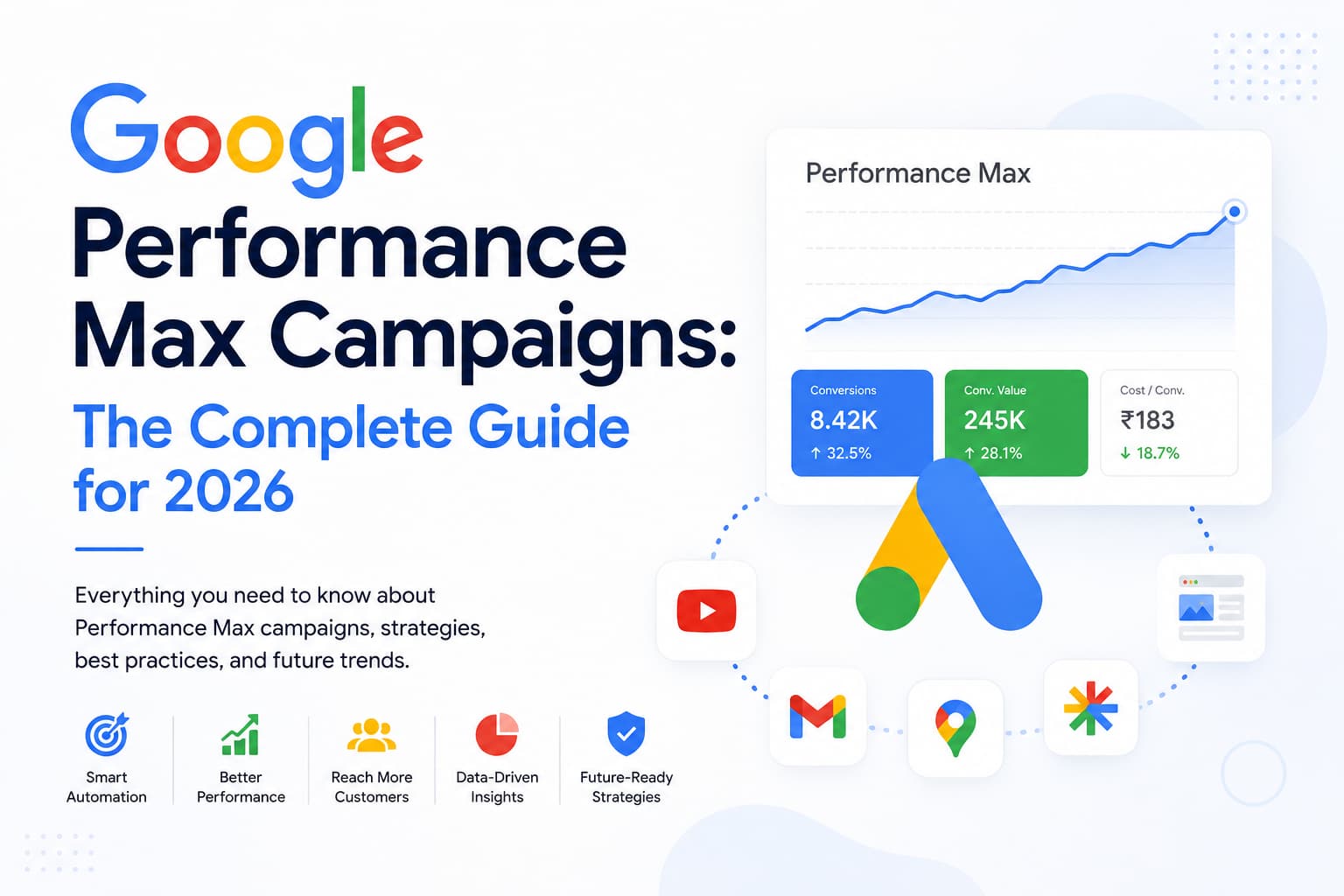
In the past, advertisers had to set up multiple separate campaigns to reach users across different Google platforms such as Search, Display, YouTube, and Discover. This created a major challenge: managing multiple campaigns, budgets, audiences, and performance reports simultaneously often led to inefficiencies and missed optimization opportunities.
To solve this complexity, Google introduced a unified campaign type known as Performance Max Campaigns. This innovation brought automation, consolidation, and cross-channel reach under a single campaign structure, fundamentally changing how advertisers approach digital advertising.
Introduction to Google Performance Max Campaigns
Google Performance Max Campaigns (PMax) were first introduced in beta in 2020 and rolled out globally in 2021. Over time, they have become one of the most important campaign types within Google Ads Performance Max advertising.
The core idea behind Performance Max is simple: instead of creating separate campaigns for each Google network, advertisers can now run a single campaign that automatically distributes ads across all Google inventory, including:
- Google Search
- YouTube
- Display Network
- Gmail
- Discover
- Maps
This makes Google Performance Max a powerful example of Google Ads automation, where machine learning takes over much of the manual campaign management work.
By using Performance Max Campaigns, advertisers can focus more on strategy, creative direction, and business goals rather than day-to-day campaign adjustments.
How Performance Max Campaigns Work

To understand Performance Max Campaigns, it is important to understand how the system operates behind the scenes.
1. Goal-Based Campaign Setup
Every Performance Max campaign setup begins with selecting a clear business objective. Common goals include:
- Lead generation
- Online sales
- Website traffic
- Local store visits
This goal helps Google’s AI determine how to optimize delivery.
2. Asset Submission
Advertisers provide creative inputs such as:
- Headlines
- Descriptions
- Images
- Videos
- Logos
These inputs are grouped into asset groups, which act as building blocks for ad creation. Google’s system then automatically mixes and matches these assets to generate high-performing ad combinations.
3. Audience Signals
Although Performance Max relies heavily on automation, advertisers can guide the system using audience signals. These are not strict targeting rules but rather suggestions that help the algorithm learn faster.
Examples include:
- Website visitors
- Customer email lists
- Similar audience segments
- Custom intent data
4. Smart Delivery Using Machine Learning
Once the campaign is live, Google uses smart bidding and real-time data signals to decide:
- Where ads should appear
- Which audience is most likely to convert
- Which creative combination performs best
This is where PPC automation becomes powerful, as manual bidding is replaced by automated optimization based on conversion probability.
Key Benefits of Performance Max Campaigns
Using Google Performance Max Campaigns offers several advantages for advertisers:
1. Unified Campaign Management
Instead of managing multiple campaigns across platforms, everything is consolidated into one system.
2. Cross-Channel Reach
Your ads automatically appear across all Google channels without separate setup.
3. AI-Driven Optimization
Machine learning continuously improves performance based on real-time conversion data.
4. Better Lead Generation Potential
For businesses focused on Performance Max lead generation, the system identifies high-intent users more efficiently than traditional campaigns.
5. Time Efficiency
Marketers can focus on strategy instead of repetitive optimization tasks.
Performance Max Campaign Setup (Step-by-Step)

A proper Performance Max campaign setup is critical for success. Here’s how to structure it effectively:
Step 1: Define Clear Conversion Goals
Before launching, ensure your conversion tracking is properly configured. Without accurate tracking, the system may optimize for the wrong actions.
Step 2: Organize Campaign Structure
A strong Performance Max strategy often involves separating campaigns based on:
- Product categories
- Profit margins
- Customer lifecycle stage (new vs returning customers)
Step 3: Build Strong Asset Groups
Each asset group should focus on a specific theme or product line. High-quality creative assets improve ad relevance and engagement.
Step 4: Add Audience Signals
Use customer data, remarketing lists, and intent signals to guide the algorithm in the early learning phase.
Step 5: Set Budget and Bidding Strategy
Google uses smart bidding to optimize conversions within your budget. Ensure your budget is realistic enough for machine learning to gather data effectively.
Performance Max Optimization Strategies
Effective Performance Max optimization is essential for long-term success. While automation handles most tasks, advertisers still play a crucial strategic role.
1. Fix Conversion Tracking First
Accurate conversion tracking is the foundation of campaign success. If incorrect events are tracked, optimization will lead to poor results.
2. Improve Asset Quality
High-performing campaigns rely heavily on strong creatives. Regularly test:
- New headlines
- Visual variations
- Video content
This improves asset group performance over time.
3. Use Audience Signals Wisely
Although not strict targeting, audience signals help guide the system toward the right users faster.
4. Optimize Based on Insights
Instead of focusing only on ROAS, analyze:
- Search term insights
- Audience performance trends
- Product-level performance
5. Apply Campaign Segmentation
A strong Performance Max strategy involves separating campaigns based on funnel stage:
- Awareness campaigns
- Consideration campaigns
- Conversion-focused campaigns
Performance Max Best Practices
Following Performance Max best practices ensures consistent performance improvement:
- Use high-quality creative assets
- Maintain clean conversion tracking setup
- Avoid overloading a single campaign with too many goals
- Continuously refresh creatives to avoid fatigue
- Use clear and structured asset groups
- Monitor performance trends weekly
These practices ensure better Performance Max targeting and improved ROI.
Performance Max for Lead Generation
Performance Max lead generation is one of the most widely used applications of this campaign type.
To improve lead quality:
- Optimize landing pages for conversions
- Use qualified conversion actions (not just clicks)
- Exclude irrelevant traffic using negative signals indirectly through data
- Focus on high-intent audience signals
Over time, the system becomes more efficient at identifying users who are most likely to convert.
Role of Automation in Performance Max
Automation is at the core of this campaign type. Google Ads automation and PPC automation work together to:
- Automate bidding
- Optimize placements
- Adjust targeting dynamically
- Test multiple ad combinations simultaneously
This reduces manual workload while improving scalability.
However, automation works best when supported with strong strategy and accurate data inputs.
Common Mistakes to Avoid
Even though Performance Max is powerful, advertisers often make mistakes such as:
- Using weak or incomplete conversion tracking
- Not providing enough creative assets
- Running too many mixed goals in one campaign
- Ignoring performance insights
- Expecting immediate results without learning phase patience
Avoiding these mistakes significantly improves campaign stability.
Future of Performance Max Campaigns
As automation continues to evolve, Performance Max Campaigns are expected to become even more intelligent. With improvements in AI, audience modeling, and predictive analytics, advertisers will rely more on strategic inputs rather than manual optimization.
This shift clearly indicates that the future of digital advertising is heavily driven by automation, data, and machine learning.
Conclusion
Performance Max Campaigns represent a major shift in how digital advertising works within the Google ecosystem. By combining automation, machine learning, and cross-channel delivery, they simplify campaign management while improving performance potential.
When implemented with the right Performance Max strategy, strong conversion tracking, well-structured asset groups, and effective audience signals, businesses can significantly improve lead generation, conversions, and overall ROI.
However, success still depends on human strategy. Automation is powerful, but it performs best when guided by accurate data, creative quality, and continuous optimization. Contact Squareit Solutions today for a quick campaign check-up, and let’s uncover your hidden growth opportunities.
FAQs
1. What are Performance Max Campaigns?
Performance Max Campaigns are automated campaign types in Google Ads that run across all Google networks using a single campaign structure.
2. How do Performance Max Campaigns work?
They use machine learning and smart bidding to automatically optimize ads based on conversion goals and audience behavior.
3. Are Performance Max Campaigns good for lead generation?
Yes, Performance Max lead generation is highly effective when conversion tracking and audience signals are properly set up.
4. What are asset groups in Performance Max?
Asset groups are collections of creatives like headlines, images, and videos used by Google to create ads automatically.
5. How can I optimize Performance Max campaigns?
Focus on conversion tracking, asset quality, audience signals, and continuous performance monitoring.
6. Is manual targeting possible in Performance Max?
No direct manual targeting is available. Instead, you provide audience signals and let the system optimize delivery.
7. What is the biggest advantage of Performance Max?
The biggest advantage is full automation across all Google channels with a single campaign setup.
8. Do Performance Max campaigns replace other Google Ads campaigns?
Not completely, but they are becoming a central part of Google Ads Performance Max strategy for many advertisers.

.png)
.png)