



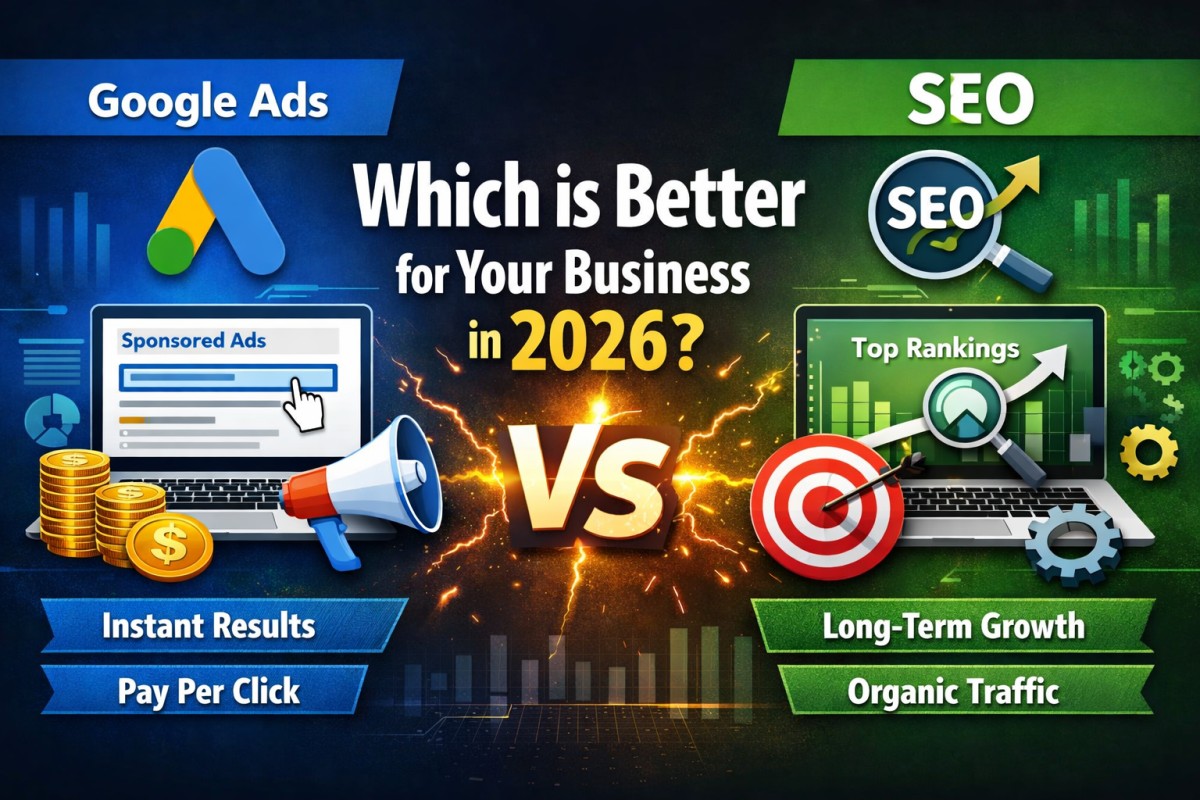
Google Ads vs SEO: Which is Better for Your Business in 2026?
In today’s fast-evolving digital landscape, businesses are constantly debating Google Ads vs SEO to decide which strategy delivers the best results. Both are powerful online marketing channels, but they serve different purposes depending on your goals, budget, and timeline.
If you’re confused about whether to invest in paid search advertising or focus on organic traffic growth, this detailed guide will help you make the right decision in 2026.
What is Google Ads?
Google Ads is a paid advertising platform where businesses bid on keywords to display their ads on search engine results pages (SERPs).
Key Features of Google Ads
- Instant visibility on top of search results
- Pay-per-click (PPC) model
- Advanced audience targeting
- Measurable results with real-time data
How It Works
You bid on keywords, and every time someone clicks your ad, you pay a cost per click (CPC). The higher your bid and quality score, the better your ad placement.
What is SEO?
SEO (Search Engine Optimization) focuses on improving your website’s search engine rankings organically without paying for clicks.
Key Components of SEO
- On-page optimization (content, keywords, structure)
- Off-page SEO (backlinks, authority building)
- Technical SEO (site speed, mobile-friendliness)
Goal of SEO
To drive consistent and sustainable organic traffic growth over time.
Google Ads vs SEO: Quick Comparison Table
PPC vs SEO Benefits
Understanding the PPC vs SEO benefits is essential when building a strong digital marketing strategy.
Benefits of Google Ads
- Immediate traffic and leads
- Google Ads allows your business to appear at the top of search results instantly, helping you generate website visits and leads as soon as your campaign goes live.
- Ideal for new businesses
- If your website is new and doesn’t yet rank on search engines, Google Ads can quickly bring visibility and attract potential customers.
- Highly targeted campaigns
- You can target specific audiences based on location, keywords, interests, device type, and user behavior, ensuring your ads reach the right people.
- Easy to scale
- Campaigns can be adjusted anytime—whether increasing budget for better performance or reducing spend when needed—making it flexible and controllable.
Benefits of SEO
- Long-lasting results
- SEO provides sustainable growth. Once your website ranks on search engines, it can continue to attract visitors consistently without needing constant investment, unlike paid ads that stop when the budget ends.
- Builds credibility and trust
- Websites that appear in organic search results are generally perceived as more trustworthy by users. High rankings signal authority, helping your brand gain customer confidence.
- Higher ROI over time
- While SEO requires time and effort in the beginning, it delivers long-term value. As your rankings improve, you receive continuous traffic without paying for each click, leading to better returns on investment.
- No ongoing cost per click
- Unlike paid advertising, you don’t have to pay for every visitor who clicks on your website. Once your pages rank, traffic comes organically, reducing long-term marketing costs.

Paid Ads vs Organic Traffic: Which is Better?
This is one of the most common debates: paid ads vs organic traffic.
Paid Ads (Google Ads)
Paid Ads (Google Ads) refer to an online advertising method where businesses pay to display their ads on search engine results pages and across Google’s network. It operates on a pay-per-click (PPC) model, meaning you are charged only when someone clicks on your ad.
Organic Traffic (SEO)
- Best for:
- Brand authority
- Consistent traffic
- Long-term business growth
Insight: Paid ads give speed, while SEO gives stability.
ROI Comparison Marketing: Google Ads vs SEO
When it comes to ROI comparison marketing, both strategies perform differently depending on time.
Short-Term ROI:
Google Ads delivers fast returns by placing your business instantly in front of high-intent users, generating immediate clicks, traffic, and conversions without waiting for long-term organic growth strategies.
Long-Term ROI
- SEO dominates
- Compounds over time with minimal cost
Example ROI Scenario
Cost Analysis: CPC vs SEO Investment
Google Ads Cost
Google Ads cost refers to the amount a business spends to run paid advertising campaigns on Google. It mainly depends on a cost per click (CPC) model, where you pay only when someone clicks on your ad.
The total cost varies based on factors like keyword competition, industry, targeting options, and ad quality. Highly competitive keywords usually have higher costs, while better ad relevance can reduce your spending.
SEO Cost
- Investment in content and optimization
- No direct cost per visitor
- Requires patience and consistency
Conclusion: Google Ads is like renting traffic, while SEO is like owning an asset.
Conversion Rate Optimization in Both Strategies
Conversion rate optimization (CRO) plays a crucial role in both SEO and PPC.
In Google Ads
- A/B testing ad copies
- Landing page optimization
- Audience targeting
In SEO
- Improving user experience
- Optimizing content structure
- Better internal linking
Long Term vs Short Term Marketing
Understanding long term vs short term marketing helps you choose wisely.
Google Ads (Short-Term)
Google Ads is a powerful short-term marketing strategy designed to deliver quick and measurable results. It allows businesses to appear instantly at the top of search results, helping generate traffic, leads, and sales without delay.
Key Points
- Quick results: Start getting clicks and conversions as soon as the campaign goes live
- Immediate visibility: Reach potential customers instantly
- Best for promotions: Ideal for limited-time offers, product launches, and urgent campaigns
SEO (Long-Term)
- Builds brand authority
- Sustainable traffic
Smart businesses use both for balance.
Lead Generation Strategy: Which Works Better?
Both Google Ads and SEO are effective for lead generation strategy, but their approach differs.
Google Ads for Leads
- High-intent users
- Faster conversions
- Great for service-based businesses
SEO for Leads
- Informational + transactional traffic
- Builds trust before conversion
- Better for long-term customer acquisition

When Should You Choose Google Ads?
Choose Google Ads if you:
- Need instant results
- Have a flexible marketing budget
- Are launching a new product or service
- Want quick testing of keywords
When Should You Choose SEO?
You should choose SEO when your goal is to build a strong, long-term online presence and generate consistent traffic without relying heavily on paid ads.
Choose SEO if you:
Want long-term growth
SEO helps your website rank higher over time, bringing continuous traffic and visibility.
Have time to build authority
It requires patience, but gradually establishes your brand as a trusted source in your industry.
Aim for consistent traffic
Once your pages rank, they can attract visitors regularly without ongoing advertising costs.
Want to reduce dependency on paid ads
SEO minimizes the need for constant ad spending by generating organic traffic.
Best strategy in 2026: Combine Both
In 2026, the smartest approach is not choosing one—it’s combining both.
Hybrid Strategy Benefits
- Immediate traffic from Google Ads
- Long-term growth from SEO
- Better overall ROI
- Stronger brand presence
Example Strategy Plan
- Use Google Ads for quick leads
- Invest in SEO for future traffic
- Retarget users through ads
Future Trends: Google Ads vs SEO in 2026
Google Ads Trends (2026)
- AI-powered automation – Smarter bidding, targeting, and optimization
- Focus on user intent – Beyond keywords, more on search behavior
- Rise of automated campaigns – Performance Max and AI-driven ads
- Importance of first-party data – Better targeting with owned data
- Growth of video ads – Short-form and visual content gaining traction
- Higher competition & CPC – Increased ad costs in competitive markets
SEO Trends (2026)
- AI-driven search optimization – Content must be optimized for AI-generated answers and summaries, not just traditional rankings
- Focus on user intent & quality content – Search engines prioritize helpful, clear, and valuable content over keyword stuffing
- Rise of zero-click searches – Users get answers directly on Google, reducing website clicks
- E-E-A-T is more important – Experience, expertise, authority, and trust strongly impact rankings
- Growth of AI Overviews in SERPs – AI summaries are reshaping how users interact with search results
- Multi-platform SEO – Optimization now includes platforms like YouTube, Reddit, and AI tools—not just Google
- High-quality content wins – Original, in-depth, and useful content performs better than mass-produced content

Final Conclusion
When comparing Google Ads vs SEO, there is no one-size-fits-all answer.
- If you need instant visibility and fast results, Google Ads is your best option.
- If you want long-term growth and sustainable traffic, SEO is the better choice.
However, the most effective digital marketing strategy in 2026 is to combine both. Use Google Ads for quick wins and SEO for lasting success.
Think of it this way:
- Google Ads = Speed
- SEO = Stability
Together, they create a powerful marketing engine that drives consistent traffic, leads, and revenue.
FAQs
1. Is SEO better than Google Ads in 2026?
SEO is better for long-term growth, while Google Ads is better for immediate results. The best approach is to use both together.
2. Which is more cost-effective: SEO or Google Ads?
SEO is more cost-effective in the long run since it doesn’t require paying per click, unlike Google Ads.
3. Can I run Google Ads without SEO?
Yes, but relying only on ads can be expensive. SEO helps reduce long-term costs and builds trust.
4. How long does SEO take to show results?
SEO typically takes 3–6 months to show noticeable results, depending on competition and strategy.
5. Should small businesses choose SEO or Google Ads?
Small businesses should start with Google Ads for quick visibility and gradually invest in SEO for long-term success.