





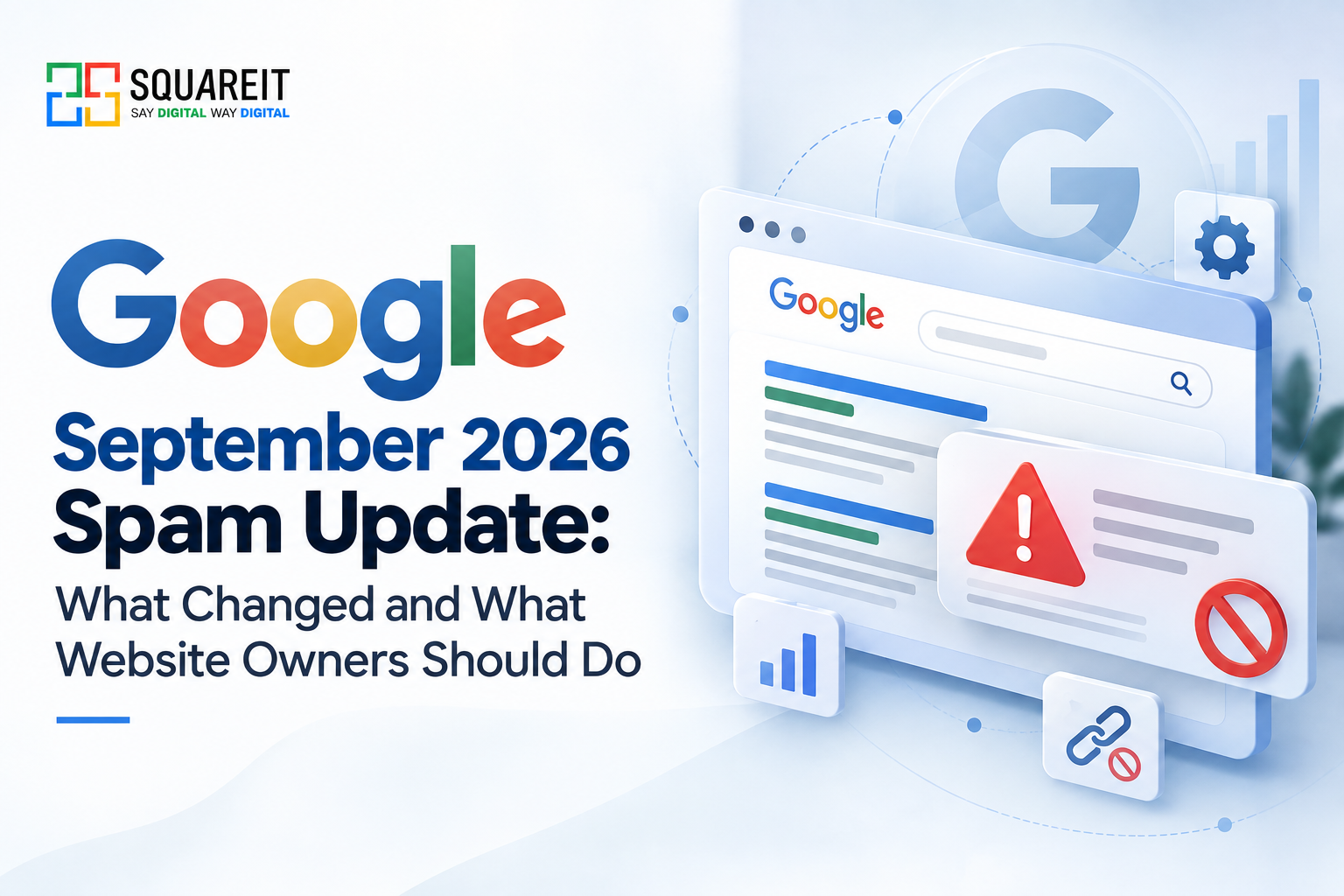
Google began rolling out the September 2026 Spam Update on September 24, 2026, as a global update covering all languages and locations. The rollout is expected to take up to two weeks. Unlike a core update, this release focuses on improving Google’s existing spam-detection systems, with no specific spam tactic announced as its primary target. This article explains the five major areas website owners should understand, including potential ranking fluctuations, spam-policy risks, monitoring strategies, and recovery steps. It also covers practices such as keyword stuffing, link spam, cloaking, scraping, and scaled content abuse, while explaining how website owners can respond to a website traffic drop without making rushed SEO changes.
Google has started rolling out the Google spam update September 2026, giving website owners another reason to review their SEO practices and search visibility. The rollout began on September 24, 2026, and Google has indicated that it can take up to two weeks to complete.
This is the fourth reported spam update of 2026, following spam-related updates in March, June, and August. Google has characterized the September release as a regular spam update affecting all languages and locations globally. At this stage, Google has not identified a specific spam tactic as the sole target of this update.
That distinction matters. A sudden ranking movement during the rollout does not automatically mean that a website has been penalized for a particular SEO technique. Google's spam systems continuously evolve, and an update can change how existing forms of search manipulation are detected.
For website owners, the focus should therefore be on reviewing existing SEO practices, identifying potentially risky patterns, monitoring performance carefully, and avoiding rushed changes based only on short-term ranking fluctuations.
What Happened: Dates and Rollout Timeline
The Google spam update September 2026 officially began rolling out on September 24, 2026.
Google describes this type of release as a spam update rather than a core update. The rollout applies globally and across languages, meaning websites in different countries and industries can experience changes while the systems are being updated.
September 2026 Spam Update Timeline
One of the most important points is that the rollout is not complete immediately. Ranking changes observed during the first few days should therefore be treated cautiously.
A website could see rankings fall temporarily and later recover as the rollout progresses. Similarly, a short-term increase does not necessarily mean the site has permanently benefited from the update.
Five Major Things to Understand About This Update
Although Google has not announced a specific new spam tactic, website owners should pay particular attention to five areas:
1. Existing spam detection is being improved
The update should be viewed primarily as an improvement to Google's existing ability to identify spam and manipulative search practices.
2. There is no announced single target
Google has not stated that the September update specifically targets link spam, AI content, keyword stuffing, or another individual tactic.
3. The update is global
The rollout applies across languages and locations rather than being restricted to a particular country or language.
4. Rankings can fluctuate during reassessment
Even websites that are not violating spam policies can experience temporary movement while Google's systems reassess search results.
5. Short-term traffic changes are not automatically permanent
A sudden website traffic drop during the rollout should be investigated, but it should not immediately be treated as a permanent penalty.
Spam Update vs Core Update: What's the Difference?
One of the easiest ways to misunderstand the Google algorithm update 2026 landscape is to treat every ranking update as a core update.
Google's different update types can have different purposes.
What Is a Spam Update?
A spam update focuses on improving Google's systems for detecting and handling content or websites that violate its spam policies.
The objective is to reduce the visibility of websites using practices intended to manipulate Google's search results.
Examples can include:
- Cloaking
- Keyword stuffing
- Link spam
- Scaled content abuse
- Scraping
- Misleading functionality
- Other manipulative search practices
A website that violates Google's spam policies may experience reduced visibility or may not appear in relevant search results.
What Is a Core Update?
A core update is broader. It can change how Google's systems evaluate and rank content across many different types of queries.
A ranking decline following a core update does not necessarily mean the website violated a spam policy.
This distinction is particularly important during September 2026 because website owners may see ranking changes and incorrectly assume that their site has received a spam action.
Ranking fluctuation ≠ automatic spam violation.
Before making major SEO changes, website owners should examine the timing, affected pages, queries, technical issues, competitors, and Search Console data.
Signs Your Site May Be Affected
Not every ranking change during the rollout indicates a spam problem.
However, several patterns deserve closer investigation.
A Sudden Website Traffic Drop
A noticeable decline in organic traffic is one of the first things website owners may notice.
For example, you might see:
- Organic clicks declining
- Search impressions falling
- Important keywords losing visibility
- Multiple pages losing rankings simultaneously
- Previously visible pages receiving fewer impressions
- Leads or enquiries declining
However, traffic alone cannot tell you why the change happened.
Check whether the decline began around September 24 or whether it started earlier. Also compare individual pages and search queries rather than looking only at total website traffic.
A Large Number of Keywords Declining Together
If dozens or hundreds of keywords decline simultaneously, it is worth investigating whether a broader site-level issue exists.
Look for common characteristics among affected pages:
- Similar content structures
- Heavy keyword repetition
- Automatically generated pages
- Thin content
- Scraped material
- Manipulative internal linking
- Unnatural external links
- Pages created primarily for search engines
Important Pages Disappearing From Search
A particularly significant warning sign is when pages that previously appeared consistently for relevant searches become difficult to find.
However, don't immediately assume they were removed because of spam.
Check:
- Whether the URL is indexed.
- Whether the page is accessible.
- Whether there are technical indexing problems.
- Whether the page has changed recently.
- Whether the search query itself has changed.
- Whether competitors have become more relevant.
Search Console Messages
Google Search Console can provide useful information when Google takes a manual action against a website.
A manual action is different from ordinary algorithmic ranking fluctuation.
Therefore, check Manual Actions and other Search Console reports before concluding that a ranking decline is a spam penalty.
What to Do During the Rollout — and What Not to Do
The safest approach during a major Google rollout is observation first, reaction second.
What You Should Do
Monitor Google Search Console
Track:
- Clicks
- Impressions
- Average position
- CTR
- Top-performing pages
- Top search queries
- Country/device changes
Compare the data with previous periods rather than relying on one day's performance.
Review Your Highest-Value Pages
Start with pages that generate significant organic traffic or leads.
Look for obvious quality or spam-related problems such as excessive keyword repetition, copied content, doorway-style pages, or content created primarily to manipulate rankings.
Audit Your Backlink Profile
Review unusual links pointing to your website.
The objective isn't to remove every low-authority link. Instead, look for obvious patterns of manipulative link building.
Check Content Quality
Ask:
- Does the page genuinely answer the user's question?
- Is the information useful?
- Does it provide original value?
- Is the content unnecessarily repetitive?
- Was the page created primarily to attract search traffic?
- Are keywords being inserted unnaturally?
Keep Tracking Until the Rollout Ends
Don't make ten major changes simultaneously.
If you change your content, URLs, internal linking, technical setup and backlinks all at once, it becomes much harder to determine what actually affected performance.
What You Should Not Do
Avoid panic-driven SEO decisions.
Don't:
- Delete large numbers of pages without analysis.
- Rewrite your entire website overnight.
- Remove all backlinks indiscriminately.
- Stuff additional keywords into declining pages.
- Buy large quantities of backlinks.
- Publish hundreds of low-value pages to compensate for lost traffic.
- Assume every ranking decline is a penalty.
- Make major changes based on one or two days of data.
The best response to an algorithm update is generally a structured audit rather than an emergency overhaul.
Google's Spam Policies Explained Simply
Google's spam policies cover practices that attempt to manipulate search rankings or create misleading experiences.
Here are some important categories in simple terms.
Cloaking
Cloaking occurs when a website presents substantially different content to search engines and users.
For example, a crawler might see one version of a page while visitors receive something substantially different.
Keyword Stuffing
Keyword stuffing means excessively inserting keywords into content, metadata, or other parts of a page in an attempt to manipulate rankings.
For example, repeatedly writing:
"best dentist in Lucknow, best dentist Lucknow, dentist Lucknow, top dentist Lucknow..."
without adding useful information can make content unnatural and unhelpful.
Keywords should describe the topic naturally rather than dominate the writing.
Link Spam
Link spam involves manipulating links to influence search rankings.
Examples can include purchasing links intended to pass ranking signals, excessive link exchanges, automated link creation, or other manipulative schemes.
Having a backlink isn't automatically spam. Context and intent matter.
Scaled Content Abuse
Creating large amounts of content primarily to manipulate search rankings rather than help users can create problems.
The important issue isn't simply the number of pages or whether AI was involved. The concern is whether content is being produced at scale without sufficient user value and primarily to influence search visibility.
Scraping
Scraping involves taking content from other websites and republishing it without providing meaningful original value.
A website built largely from copied material may have difficulty demonstrating why its pages deserve to rank.
Misleading Functionality
Websites should provide the functionality they promise.
A page should not trick users into clicking something, downloading something, submitting information, or completing an action that differs substantially from what the page communicates.
How to Recover If You Were Hit
If your website experiences a significant decline, don't immediately assume that recovery requires a complete website rebuild.
Start by identifying what changed and where.
Step 1: Establish the Date of Decline
Compare your Search Console data before and after September 24.
Identify whether the decline:
- Started before the rollout
- Started during the rollout
- Increased gradually
- Happened suddenly
- Affected specific pages or the entire site
Step 2: Identify the Affected Content
Create a list of pages that lost the most clicks and impressions.
Then compare those pages with pages that remained stable.
This can reveal patterns.
Step 3: Review Spam Risks
Check affected pages for:
- Keyword stuffing
- Duplicate or scraped content
- Scaled low-value content
- Manipulative links
- Cloaking
- Doorway-style pages
- Misleading elements
Step 4: Improve the Underlying Problem
Don't simply change words to make a page "look less spammy."
Address the actual issue.
For example, if a page is thin, expand it with genuinely useful information. If content is duplicated, consolidate or differentiate it where appropriate. If your SEO strategy relied heavily on manipulative links, reassess the link strategy.
Step 5: Give Google Time to Reprocess Changes
After making meaningful improvements, don't expect immediate recovery.
Search systems need time to crawl, process and reassess pages.
Also remember that a ranking decline may have multiple causes. A spam update could coincide with other ranking changes, technical problems, seasonal demand changes, or increased competition.
What Website Owners Should Focus on After the Update
The September update is a useful reminder that sustainable SEO is not simply about adding more keywords or publishing more pages.
Website owners should build their SEO strategy around:
Useful content: Create pages that genuinely solve users' problems.
Natural optimization: Use relevant keywords where they make sense instead of repeating them excessively.
Technical accessibility: Make sure important pages can be crawled, indexed and accessed properly.
Trust and transparency: Clearly communicate who operates the website, what products or services are offered, and what users can expect.
Responsible link building: Focus on legitimate relationships, useful resources and genuine references rather than manipulative link schemes.
Continuous monitoring: Use Search Console and analytics to identify meaningful trends instead of reacting to isolated ranking movements.
Frequently Asked Questions
1. What is the Google spam update September 2026?
The Google spam update September 2026 is a global spam-focused algorithm update that began rolling out on September 24, 2026. Google has described it as a regular spam update affecting all languages and locations.
2. How long will the September 2026 spam update take?
Google's rollout is expected to take up to approximately two weeks. Website owners should wait until the rollout has progressed before drawing strong conclusions from temporary ranking changes.
3. Is the September 2026 update targeting AI-generated content?
There has been no announcement identifying AI-generated content as the specific target of this update. Website owners should instead evaluate whether their content provides genuine value and complies with Google's existing spam policies.
4. Can a website experience a traffic drop without violating Google's spam policies?
Yes. Ranking systems can produce fluctuations during an update, and other factors can affect organic traffic. A website traffic drop alone does not prove a spam violation.
5. Does losing rankings mean Google has penalized my website?
Not necessarily. Algorithmic ranking changes and manual actions are different. Check Google Search Console for manual-action information and investigate technical, content, competition and search-demand factors before concluding that your site has been penalized.
6. Should I change my website during the rollout?
Avoid making large, rushed changes based only on short-term fluctuations. Monitor performance, identify genuine problems and make improvements based on evidence.
7. What Google spam policies should website owners review?
Important areas include cloaking, keyword stuffing, link spam, scaled content abuse, scraping and misleading functionality, along with other practices intended to manipulate Search.
8. How can I check whether my site has been affected?
Use Google Search Console to compare clicks, impressions, CTR, positions, queries and pages before and after September 24. Also check indexing and Manual Actions.
9. Should I remove backlinks after the spam update?
Don't remove backlinks simply because they have low authority or because rankings declined. Investigate whether there is evidence of manipulative link activity before taking action.
10. How quickly can rankings recover?
There is no universal recovery timeframe. It depends on the reason for the decline, the improvements made, Google's subsequent processing and other factors affecting search results.
Final Thoughts
The Google spam update September 2026 should be approached with analysis rather than panic. The update began on September 24 and is expected to take up to two weeks, so early ranking movements may not represent the final outcome.
At present, Google has not announced a specific spam tactic as the target of this release. Therefore, SEO professionals should be careful about attributing every ranking change to a particular technique without supporting evidence.
For website owners, the practical response is straightforward: monitor performance, review Google's spam policies, identify genuine risks, improve content quality, maintain natural SEO practices and allow the rollout to progress before making major conclusions.