





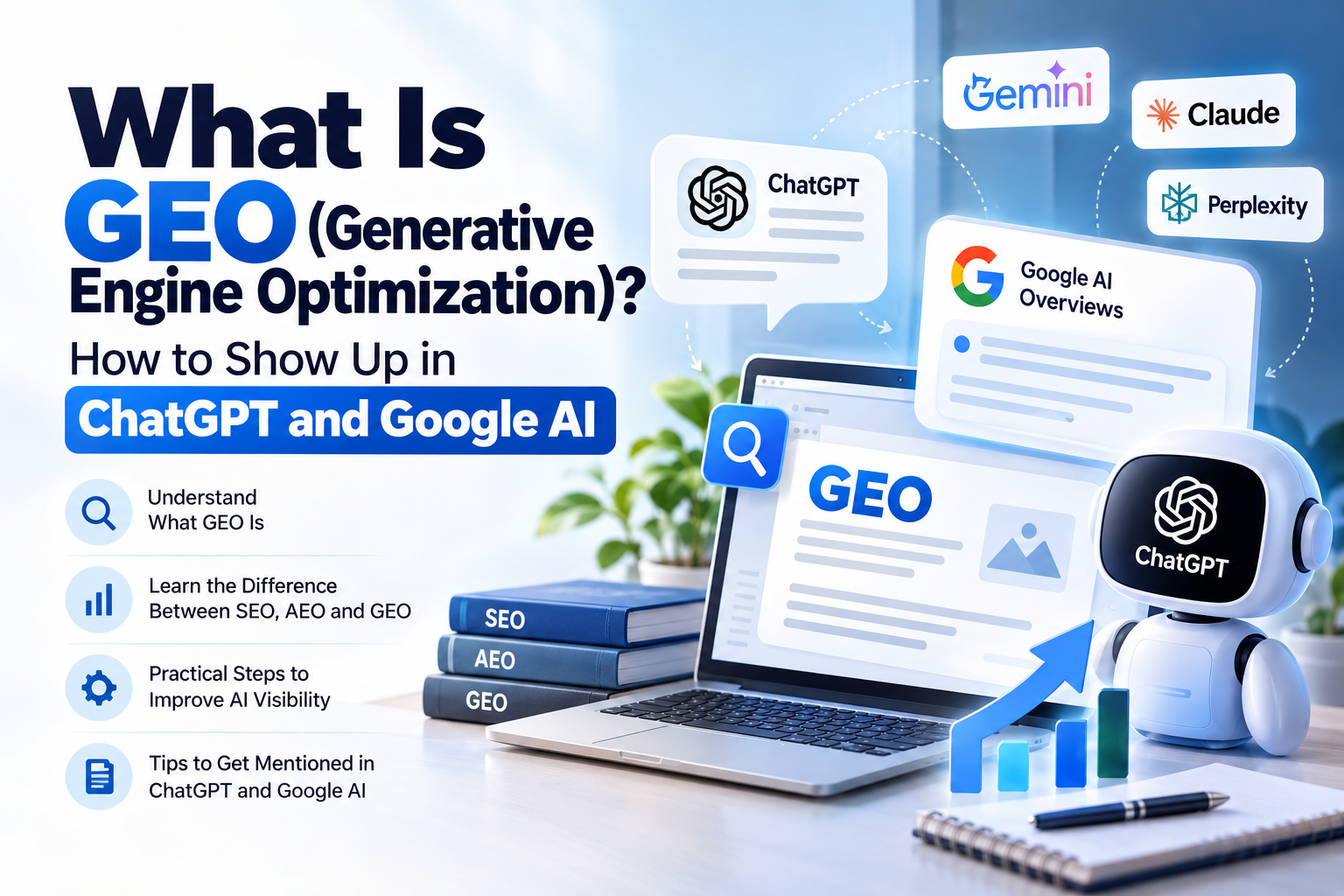
GEO (Generative Engine Optimization) helps AI platforms like ChatGPT, Gemini, and Perplexity understand and potentially reference your brand and content. It focuses on clear, trustworthy, well-structured, and useful information, supported by SEO, FAQs, reviews, structured data, and expert content.
This change has created a new area of digital marketing called Generative Engine Optimization (GEO). GEO focuses on creating clear, useful, trustworthy, and well-structured content that can be understood and referenced by AI-powered search and answer systems.
If you are wondering what is GEO in SEO, the simple answer is that GEO is an approach that helps your website, brand, products, or expertise become more understandable and discoverable in AI-generated answers.
What Is GEO in SEO?

GEO stands for Generative Engine Optimization. It is the practice of improving online content so that generative AI systems can better understand, process, and potentially reference information about a website, business, product, service, or topic.
Traditional search engines usually provide a list of web pages for a user's query. Generative AI tools can take information from multiple sources and generate a direct response based on the user's question and context.
For example, a person may search Google for:
"Best digital marketing agency in Lucknow"
They may receive a list of websites and businesses.
However, a user might ask an AI assistant:
"What should I look for when choosing a digital marketing agency in Lucknow?"
The AI system may create a detailed answer using information from different sources.
This is where generative engine optimization becomes important. Your goal is not simply to create content around keywords. You also need to make your information clear, accurate, useful, and easy for AI systems and users to understand.
GEO does not replace traditional SEO. Instead, it works alongside SEO and other digital marketing practices.
SEO vs GEO

SEO and GEO have different focuses, but they also have many similarities.
- SEO stands for Search Engine Optimization and focuses on improving a website's visibility in traditional search results.
- GEO stands for Generative Engine Optimization and focuses on making information useful and understandable for AI-powered search and answer experiences.
- SEO often focuses on rankings, search intent, technical performance, links, content quality, and website authority.
- GEO focuses more strongly on clarity, context, entities, factual information, brand understanding, and content that can be used to generate a useful answer.
- Both approaches benefit from high-quality, helpful, trustworthy, and technically accessible content.
For example, an SEO strategy may focus on creating a page that answers a search query and performs well in Google's search results.
A GEO strategy may additionally ensure that the same page clearly explains the topic, identifies the organization or author behind the information, provides supporting evidence, answers related questions, and uses structured information where appropriate.
The important point is that GEO should not be treated as a shortcut for getting mentioned by AI. There is no guaranteed method that forces ChatGPT or another AI system to mention a particular website.
GEO vs Traditional SEO
Traditional SEO has generally focused on improving the visibility of webpages in search engines such as Google and Bing.
Keywords are still useful because they help search engines and users understand what a page is about. However, modern search systems are much more focused on meaning, context, intent, usefulness, and the overall quality of information.
GEO takes this idea further for generative search experiences.
Instead of writing an article only around a particular keyword, you should explain the complete topic clearly.
For example, if your primary keyword is what is GEO in SEO, a useful article should not repeat that phrase in every paragraph.
Instead, it can explain:
- What GEO means
- How GEO differs from SEO
- How generative AI systems use information
- How structured data can help machines understand content
- Why original information matters
- How brand mentions can contribute to online visibility
- How businesses can monitor their presence in AI-generated answers
This creates a more complete resource for both users and search systems.
How AI Tools Choose Which Sources to Cite

AI-powered search and answer systems can use information from multiple sources when generating a response. The exact process differs between platforms, and it is not appropriate to assume that every AI tool uses the same ranking or citation system.
Generally, AI systems may consider factors such as the relevance of a source to the query, the quality and clarity of the information, the reliability of the source, available evidence, freshness where relevant, and how well the source supports the answer.
For example, if someone asks:
"What is the difference between SEO and GEO?"
An AI system may look for sources that clearly explain both concepts rather than simply selecting the page that repeats the phrase "GEO vs SEO" the most times.
This is why creating genuinely useful content is important.
AI-generated answers are also influenced by the specific wording and context of a user's question. A brand may be mentioned for one query but not another because the questions have different intent or because the available sources differ.
Therefore, how to rank in ChatGPT should not be viewed in exactly the same way as traditional Google ranking.
There is no single ranking position that guarantees visibility across every AI platform.
Instead, businesses should focus on building a strong and consistent online presence that clearly communicates what they do, who they serve, what they offer, and why their information can be trusted.
SEO vs AEO vs GEO
SEO, AEO, and GEO are related concepts, but they are not exactly the same.
SEO
SEO focuses on improving the visibility and discoverability of webpages in search engines.
AEO
AEO, or Answer Engine Optimization, focuses on creating content that directly answers questions. FAQs, concise explanations, structured content, and question-based searches are often relevant to this approach.
GEO
GEO focuses on making your information easier for generative AI systems to understand and use when producing answers.
These areas overlap significantly. A well-optimized website can support SEO, AEO, and GEO at the same time.
7 Practical Steps for Generative Engine Optimization

1. Build a Strong SEO Foundation
The first step in GEO is not to ignore SEO. Your website should have a strong technical and content foundation.
Make sure search engines and other systems can access your important pages. Your website should have a logical structure, useful internal links, readable content, descriptive page titles, and a good mobile experience.
Website speed and accessibility also matter for users.
A technically poor website can make it difficult for search systems to discover and understand your content.
Therefore, before focusing heavily on GEO, improve the basic SEO health of your website.
2. Use Structured Data Where It Makes Sense
Structured data, including appropriate Schema.org markup, can help search engines understand specific information on a webpage.
Depending on your website, relevant structured data may include information about:
- Organizations
- Local businesses
- Products
- Articles
- Events
- People
- FAQs
- Reviews, where eligible and accurately represented
Structured data should accurately describe the visible content on the page. It should not be used to provide misleading information or manipulate search results.
For example, if you have a business website, clear organization information can help systems understand your business name, website, contact information, and other relevant details.
Structured data is not a guarantee that an AI system will cite your website, but it can support machine-readable understanding of your content.
3. Optimize Content for Clarity
Clarity is one of the most important parts of GEO.
When you write an article, product description, service page, or backlink-related content, make sure the information is easy to understand.
Avoid unnecessary sentences, confusing terminology, and excessive keyword repetition.
For example, instead of writing a paragraph that repeatedly uses the phrase "generative engine optimization," explain the concept naturally and then use related terms where they are genuinely useful.
Use:
- Clear headings
- Short paragraphs
- Bullet points
- Tables where appropriate
- Definitions
- Examples
- Relevant statistics
- Supporting sources
- Direct answers to common questions
The goal is to make the page useful to a real reader first.
4. Create Clear FAQs
FAQs can help you cover the questions people commonly ask about your topic.
For example, an article about GEO can answer questions such as:
- What is GEO in SEO?
- Is GEO different from SEO?
- Does GEO replace SEO?
- How can businesses improve their visibility in AI search?
- Can schema markup help with GEO?
- How can I check whether an AI tool mentions my brand?
The answers should be concise but complete.
Do not create FAQs simply to add more keywords. Every question should provide genuine value to the reader.
5. Make Your Brand and Entity Information Clear
AI systems need context.
If your website talks about a company, product, person, service, or organization, make the identity and relationships clear.
For example, a business website should clearly explain:
- Business name
- Services or products
- Location, when relevant
- Industry
- Areas served
- Contact information
- About the organization
- Author or expert information where relevant
Consistency is also important.
Your business name, description, services, and other important information should be reasonably consistent across your website and other legitimate online profiles.
This can help create a clearer understanding of your brand across the web.
6. Build Genuine Brand Mentions and Reviews
Your website is not the only place where your business exists online.
Relevant mentions on reputable websites, industry publications, professional directories, news websites, and other legitimate platforms can contribute to your overall online presence.
Customer reviews can also provide useful information about real experiences with a business.
However, businesses should avoid creating fake reviews, artificial mentions, or large numbers of low-quality links simply to influence search or AI systems.
The goal should be to build genuine recognition and trust.
Quality and relevance are more useful than simply increasing the number of mentions.
7. Publish Original Data and Demonstrate Expertise
Original information can make your content more useful and distinctive.
Instead of rewriting the same information found on dozens of websites, consider adding:
- Original research
- Surveys
- Case studies
- First-hand observations
- Industry data
- Expert commentary
- Real examples
- Comparisons based on clearly explained criteria
Author information can also improve transparency.
For professional or expert content, consider providing a clear author bio that explains the writer's relevant experience and qualifications.
This does not guarantee AI visibility, but it helps users understand who created the information and why they may consider it relevant.
AI Overviews Optimization: What Should You Do?

AI Overviews optimization should not be treated as a separate trick or a guaranteed formula.
Google's AI-powered search experiences can change how users discover information, but the fundamentals of creating helpful content remain important.
Businesses should focus on creating pages that clearly satisfy search intent.
For example, if a user searches for "how to choose a digital marketing agency," an effective page should explain the actual decision-making factors rather than simply promoting one company.
Use clear headings, answer important questions, provide useful examples, support factual claims, and keep information updated when it can change.
Most importantly, do not create content specifically for an AI system at the expense of human readers.
Content should be created primarily to help people.
How to Check Whether AI Mentions Your Brand
If you want to understand your GEO performance, start by creating a list of questions that potential customers may ask AI tools.
For example:
- "What are the best [service] companies in my city?"
- "Which companies provide [specific service]?"
- "What should I look for when choosing a [service provider]?"
- "What is [your brand] known for?"
- "What are alternatives to [your product or service]?"
Ask similar questions across different AI platforms and record the results.
Look for:
- Whether your brand appears
- How your brand is described
- Whether your website is cited
- Which other sources are mentioned
- Whether the information is accurate
- What information appears to be missing
Do not treat one AI response as a permanent ranking.
AI responses can change based on the question, location, available sources, model updates, and other factors.
Tracking these results over time can help you identify gaps in your online presence and content strategy.
Conclusion
Generative Engine Optimization is becoming an important part of the changing search environment.
If you are asking what is GEO in SEO, remember that GEO is not simply about adding more keywords or trying to force an AI tool to mention your website.
It is about making your information clear, useful, accurate, well-structured, and easy to understand.
Traditional SEO remains important because search engines still play a major role in discovering and organizing information. A strong SEO foundation can support your GEO efforts.
At the same time, businesses should think beyond rankings and focus on the complete online presence of their brand.
Create useful content, explain your topics clearly, use appropriate structured data, provide transparent author and business information, build genuine mentions, collect authentic reviews, and publish original information when possible.
There is no guaranteed formula for how to rank in ChatGPT, Google AI, Gemini, Claude, Perplexity, or every other generative search system.
The practical approach is to build a website and online presence that deserve to be understood, discovered, referenced, and trusted.
FAQs
1. What is GEO in SEO?
2. Is GEO the same as SEO?
No. SEO focuses mainly on improving visibility in search engines, while GEO focuses on how information can be understood and potentially represented in generative AI experiences. However, both approaches share important foundations such as useful content, technical accessibility, relevance, and clear information.
3. How can I rank in ChatGPT?
There is no guaranteed ranking formula for ChatGPT. To improve your overall visibility, build a credible online presence, publish useful and original content, keep your business information consistent, provide clear entity information, and earn genuine mentions from relevant sources.
4. Does schema markup help with GEO?
Schema markup can help search systems understand specific information on a webpage. It should accurately represent the visible content on the page. However, schema markup alone does not guarantee that an AI system will cite or mention your website.
5. Does GEO replace traditional SEO?
No. GEO should generally be considered complementary to SEO rather than a replacement. Technical SEO, useful content, internal linking, accessibility, and other established SEO practices remain important for online visibility.
6. What is the difference between AEO and GEO?
AEO, or Answer Engine Optimization, focuses on providing clear answers to user questions. GEO, or Generative Engine Optimization, focuses more broadly on making information understandable and useful for generative AI systems. The two approaches can overlap.
7. How can I improve my AI search visibility?
Start with a technically accessible website and create clear, helpful content. Add relevant structured data, explain your business and expertise clearly, answer common questions, build genuine online mentions, maintain accurate information, and publish original insights where possible.
8. Is keyword stuffing useful for GEO?
No. Repeating a keyword excessively can make content difficult to read and does not create better information. Use your primary and secondary keywords naturally while focusing on the actual topic and search intent.
9. What is AI Overviews optimization?
AI Overviews optimization refers to creating content that is well positioned to be understood and potentially surfaced within Google's AI-powered search experiences. There is no guaranteed optimization formula, so businesses should focus on helpful, accurate, well-organized content and a strong overall SEO foundation.
10. Why is original content important for GEO?
Original research, case studies, first-hand experience, expert insights, and unique data can provide information that is more useful and distinctive than a simple rewrite of existing articles. It can also help demonstrate expertise and give other sources something meaningful to reference.